With rising rates of stress, anxiety and recurrent depressive episodes affecting millions worldwide, mental health has become a growing concern. The challenge isn't only to treat symptoms, but to prevent relapse, particularly in recurrent depression. To address this issue, one method has proven wildly efficient: mindfulness-based cognitive therapy. What does the scientific research say about it? This article explores the principles of MBCT and examines how innovations such as Neuromind can become complementary.
Mindfulness-based cognitive therapy: what is it for?

With rising rates of stress, anxiety and recurrent depressive episodes affecting millions worldwide, mental health has become a growing concern. The challenge isn't only to treat symptoms, but to prevent relapse, particularly in recurrent depression. To address this issue, one method has proven wildly efficient: mindfulness-based cognitive therapy. What does the scientific research say about it? This article explores the principles of MBCT and examines how innovations such as Neuromind can become complementary.
CONTEXT.
01
What is mindfulness-based cognitive therapy?
ORIGINS.
Mindfulness-based cognitive therapy (MBCT) was developed in the late 1990s by Zindel Segal, Mark Williams and John Teasdale at the University of Toronto and the University of Oxford. The program emerged from clinical observations showing that people with recurrent depression often remain vulnerable to relapse, even after remission.
The theoretical foundation of MBCT rests on a well-documented mechanism: depressive relapse is frequently triggered by automatic cognitive reactivation, particularly rumination in response to mild negative mood states [1].
To address this vulnerability, MBCT integrates two complementary methods:
cognitive therapy principles;
– mindfulness practices inspired by Jon Kabat-Zinn's mindfulness-based stress reduction (MBSR) program [2].
The objective isn't to modify the content of thoughts, but rather to help individuals become aware of mental patterns as they arise, before they escalate into full depressive episodes [1].
PURPOSE.
The primary aim of mindfulness-based cognitive therapy is to transform how individuals relate to their internal experiences. Instead of challenging their content, MBCT cultivates decentering: the ability to observe thoughts and emotions as temporary mental events rather than facts.
This shift is central to relapse prevention. Research shows that individuals who can step out of ruminative loops are significantly less likely to experience depressive recurrence [1].
A standardised MBCT program lasts eight weeks and includes:
mindfulness meditation exercises to develop awareness and non-judgmental observation;
cognitive techniques to identify and reframe automatic negative thoughts;
homework assignments and daily practice to integrate these skills into everyday life.
By fostering self-awareness and emotional regulation, MBCT empowers individuals to respond consciously rather than react to stressors [3][4].
CBT VS MBCT.
While both MBCT and CBT (cognitive behavioural therapy) target maladaptive thinking patterns, their approaches differ:
CBT focuses on changing the content of thoughts by challenging cognitive distortions;
MBCT focuses on changing the relationship to thoughts, cultivating acceptance rather than avoidance.
In other words, CBT asks "Is this thought true?" while MBCT asks "Can I notice this thought without judgment and let it pass?". This subtle shift plays a critical role in reducing relapse risk for mood disorders [5].

02
What does mindfulness-based cognitive therapy treat?
DEPRESSION.
One of MBCT's primary indications is recurrent major depressive disorder (MDD). By teaching people to step out of automatic negative thinking, mindfulness-based cognitive therapy provides an effective long-term prevention strategy, as shown in several research:
data from six randomized controlled trials (n = 593) indicate that MBCT is associated with a 43% reduction in depressive relapse risk compared with usual care for patients with three or more previous episodes, and are as efficient as continuous antidepressant treatment (for those who keep adhered) [4];
a recent study has shown that mindfulness based psychotherapies of 8 weeks prevent depressive relapses for 2 years [6];
systematic network meta‑analysis including data from 14 randomized controlled trials found that MBCT was more effective than treatment as usual in both preventing depressive relapse and delaying time to relapse, with statistically significant advantages in long‑term outcomes [7].
ANXIETY.
Beyond depression, MBCT has proven beneficial for generalized anxiety disorder, social anxiety and work-related stress [8]. Mindfulness practices reduce excessive worrying, improve attentional control and promote calmness under pressure.
For people facing chronic stress or burnout, mindfulness-based cognitive therapy offers practical tools to restore mental balance.
OTHER APPLICATIONS.
Emerging evidence suggests MBCT can support:
chronic pain management by reducing pain catastrophizing and improving coping strategies [9][10];
addiction recovery through enhanced impulse control [11];
eating disorders by increasing body awareness and reducing emotional eating [12];
overall well-being as a preventive mental health tool for healthy populations.
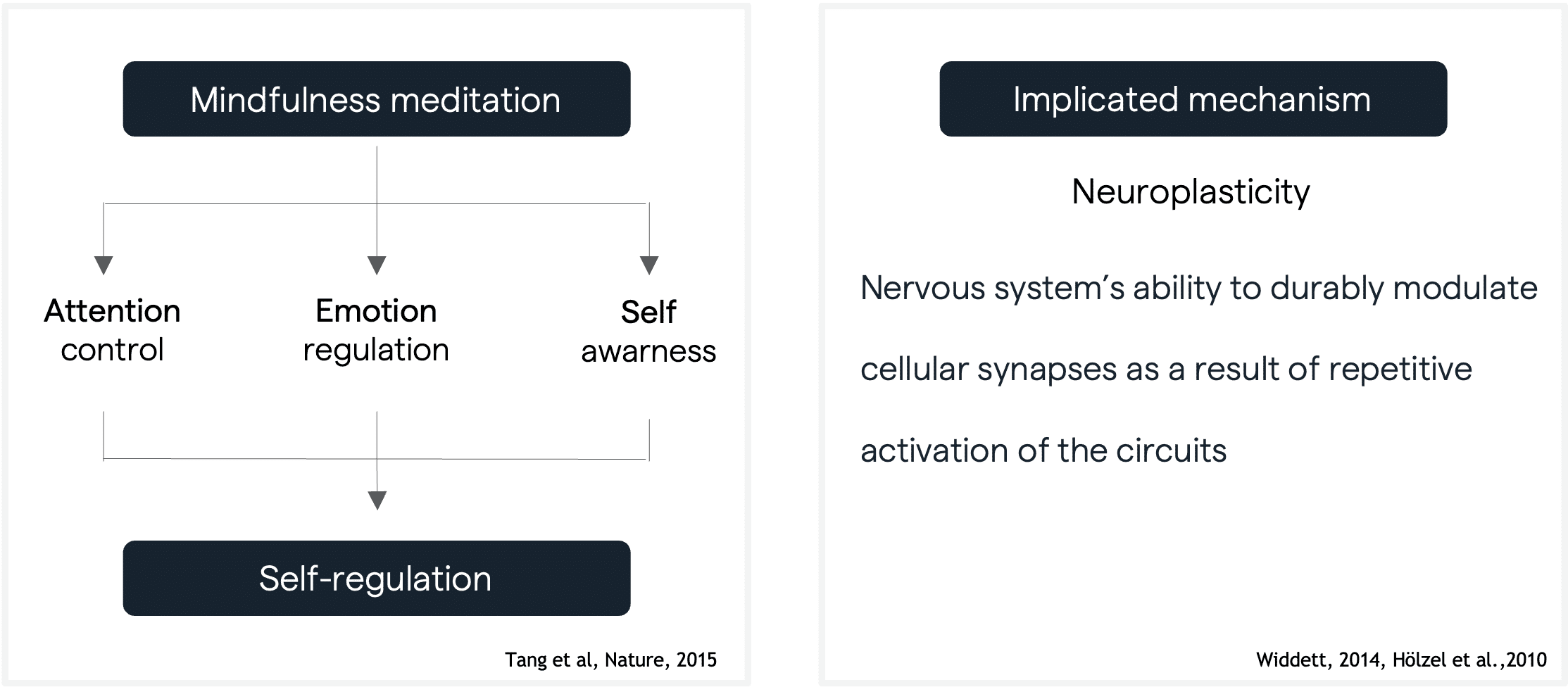
Neuroimaging studies show mindfulness-based interventions induce functional changes in brain regions involved in attention, emotion regulation and self-awareness, including the prefrontal cortex and default mode network [13].
03
Evidence and scientific validation of mindfulness-based cognitive therapy
EVIDENCE.
Mindfulness-based cognitive therapy is recognized as an evidence-based treatment and is recommended by leading health authorities such as the UK's National Institute for Health and Care Excellence (NICE) for depression relapse prevention [14].
Meta-analyses and randomized controlled trials consistently show MBCT's effectiveness in:
reducing depressive relapse compared to treatment as usual;
improving anxiety symptoms and quality of life;
enhancing resilience and emotional regulation across various populations.
CLINICAL PRACTICE.
Beyond controlled trials, MBCT has also demonstrated effectiveness in clinical settings. A large study involving routine clinical practice reported significant symptom reduction and high feasibility across diverse patient populations [15].

04
MBCT and neuro-adaptive technologies: Neuromind's positioning
FOUNDATIONS.
While mindfulness-based cognitive therapy is powerful on its own, integrating it with neuro-adaptive technologies opens new possibilities for personalisation and engagement.
Both MBCT and Neuromind focus on training mental skills rather than suppressing symptoms. Sustained attention, emotional awareness and self-regulation are gradually strengthened through repeated experiential learning [8][16].
Neuroscientific models suggest that such learning processes are supported by neuroplastic mechanisms shaped through consistent feedback and practice [13][17].
INTEGRATION.
Neuromind combines real-time neurofeedback, immersive virtual reality and affective brain-computer interfaces (aBCI) to create an adaptive environment for mindfulness and emotional training:
neurofeedback provides real-time brain activity feedback, allowing users to self-regulate neural patterns linked to stress and rumination;
virtual reality immersion enhances engagement and focus by creating calming, interactive environments that reinforce mindfulness practices;
personalized bio-adaptive approach: using proprietary biomarkers, Neuromind dynamically adjusts the experience to the user's mental state, ensuring optimal conditions for attention and emotional balance.
This integration aligns with neuroscientific evidence showing that feedback-driven training amplifies neuroplasticity and emotional self-regulation [16][17]. Rather than replacing MBCT, Neuromind positions as a technology designed to support and deepen the experiential learning processes that MBCT seeks to cultivate.
Explore how these principles are being applied to specific conditions: depression relapse prevention and addiction treatment. See all use cases or contact us to arrange a demonstration.
Mindfulness-based cognitive therapy (MBCT) is an evidence-based psychological intervention developed in the late 1990s by Segal, Williams and Teasdale. It combines cognitive therapy principles with mindfulness practices to help individuals recognise and disengage from automatic negative thinking patterns, particularly to prevent depressive relapse.
References
[1] Teasdale JD, Segal ZV, Williams JM, Ridgeway VA, Soulsby JM, Lau MA. Prevention of relapse/recurrence in major depression by mindfulness-based cognitive therapy. J Consult Clin Psychol. 2000 Aug;68(4):615-23.
[2] Kabat-Zinn J, Massion AO, Kristeller J, et al. Effectiveness of a meditation-based stress reduction program in the treatment of anxiety disorders. Am J Psychiatry. 1992 Jul;149(7):936-43.
[3] Kuyken W, Warren FC, Taylor RS, et al. Efficacy of Mindfulness-Based Cognitive Therapy in Prevention of Depressive Relapse. JAMA Psychiatry. 2016;73(6):565–574.
[4] Piet J, Hougaard E. The effect of mindfulness-based cognitive therapy for prevention of relapse in recurrent major depressive disorder: a systematic review and meta-analysis. Clin Psychol Rev. 2011 Aug;31(6):1032-40.
[5] Francis SEB, Shawyer F, Cayoun BA, et al. Differentiating mindfulness-integrated cognitive behavior therapy and mindfulness-based cognitive therapy clinically. Front Psychol. 2024 Feb 6;15:1342592.
[6] Kuyken W, Hayes R, Barrett B, et al. Effectiveness and cost-effectiveness of mindfulness-based cognitive therapy compared with maintenance antidepressant treatment in the prevention of depressive relapse or recurrence (PREVENT): a randomised controlled trial. Lancet. 2015 Jul 4;386(9988):63-73.
[7] McCartney M, Nevitt S, Lloyd A, et al. Mindfulness-based cognitive therapy for prevention and time to depressive relapse: Systematic review and network meta-analysis. Acta Psychiatr Scand. 2021 Jan;143(1):6-21.
[8] Hölzel BK, Lazar SW, Gard T, et al. How Does Mindfulness Meditation Work? Proposing Mechanisms of Action From a Conceptual and Neural Perspective. Perspect Psychol Sci. 2011 Nov;6(6):537-59.
[9] Hilton L, Hempel S, Ewing BA, et al. Mindfulness Meditation for Chronic Pain: Systematic Review and Meta-analysis. Ann Behav Med. 2017 Apr;51(2):199-213.
[10] Pei JH, Ma T, Nan RL, et al. Mindfulness-Based Cognitive Therapy for Treating Chronic Pain A Systematic Review and Meta-analysis. Psychol Health Med. 2021 Mar;26(3):333-346.
[11] Demina A, Petit B, Meille V, et al. Mindfulness interventions for craving reduction in substance use disorders and behavioral addictions: systematic review and meta-analysis. BMC Neurosci 24, 55 (2023).
[12] Liu J, Tynan M, Mouangue A, et al. Mindfulness-based interventions for binge eating: an updated systematic review and meta-analysis. J Behav Med. 2025 Feb;48(1):57-89.
[13] Stieger JR, Engel S, Jiang H, et al. Mindfulness Improves Brain-Computer Interface Performance by Increasing Control Over Neural Activity in the Alpha Band. Cereb Cortex. 2021 Jan 1;31(1):426-438.
[14] Crane RS, Kuyken W. The Implementation of Mindfulness-Based Cognitive Therapy: Learning From the UK Health Service Experience. Mindfulness (N Y). 2013;4(3):246-254.
[15] Tickell A, Ball S, Bernard P, et al. The Effectiveness of Mindfulness-Based Cognitive Therapy (MBCT) in Real-World Healthcare Services. Mindfulness (N Y). 2020;11(2):279-290.
[16] Tang YY, Hölzel BK, Posner MI. The neuroscience of mindfulness meditation. Nat Rev Neurosci. 2015 Apr;16(4):213-25.
[17] Thibault RT, Lifshitz M, Birbaumer N, Raz A. Neurofeedback, Self-Regulation, and Brain Imaging: Clinical Science and Fad in the Service of Mental Disorders. Psychother Psychosom. 2015;84(4):193-207.
Contact. If you would like further information or a demonstration of our solution, please contact us using the following link