
Use Case — Depression

Neurofeedback for depression: targeting the neural roots of relapse

A neuromodulation approach targeting the Default Mode Network overactivity that drives relapse, built to complement existing psychiatric care.

01Targets DMN overactivity, a key driver of depressive relapse
02MBCT-aligned mindfulness made measurable with neurofeedback
03Complements existing psychiatric care, not a replacement
01

The Clinical Challenge

Major depressive disorder is rarely a single episode. After an initial episode, the risk of recurrence increases with each subsequent relapse, and long-term outcomes worsen progressively. This pattern is particularly pronounced in young adults and individuals under chronic stress.

Current Care.

Current relapse prevention strategies primarily rely on long-term pharmacotherapy, psychotherapy including CBT and MBCT, and regular clinical follow-up. These approaches are effective for many patients, yet a substantial proportion do not respond adequately or discontinue treatment before lasting benefit is achieved.

A key reason is that these approaches often fail to directly address how the brain becomes locked into the patterns that make depression return — patterns that are measurable, recurring, and neurophysiological in nature.

Relapse Markers.

Depression relapse is consistently marked by:

Persistent rumination and negative self-referential thinking

Excessive self-focus and loss of attentional flexibility

Impaired capacity for emotional regulation

Automatic mood-congruent cognitive biases

02

Why the Default Mode Network Is Central to Depression Relapse

DMN in Depression.

The Default Mode Network (DMN) is a set of interconnected brain regions that becomes active when the mind turns inward — during self-reflection, autobiographical memory retrieval, and unconstrained thought.

In depression, the DMN tends to become overactive and resistant to disengagement. This has been consistently linked to:

Persistent negative self-talk and automatic self-criticism

Rumination that feels involuntary and difficult to interrupt

Difficulty redirecting attention outward toward the present environment

A subjective sense of being trapped in one's own thoughts

Vulnerability.

This matters because DMN overactivity does not disappear between episodes. It lingers during remission, creating a window of vulnerability that often goes undetected until a full relapse is already underway.

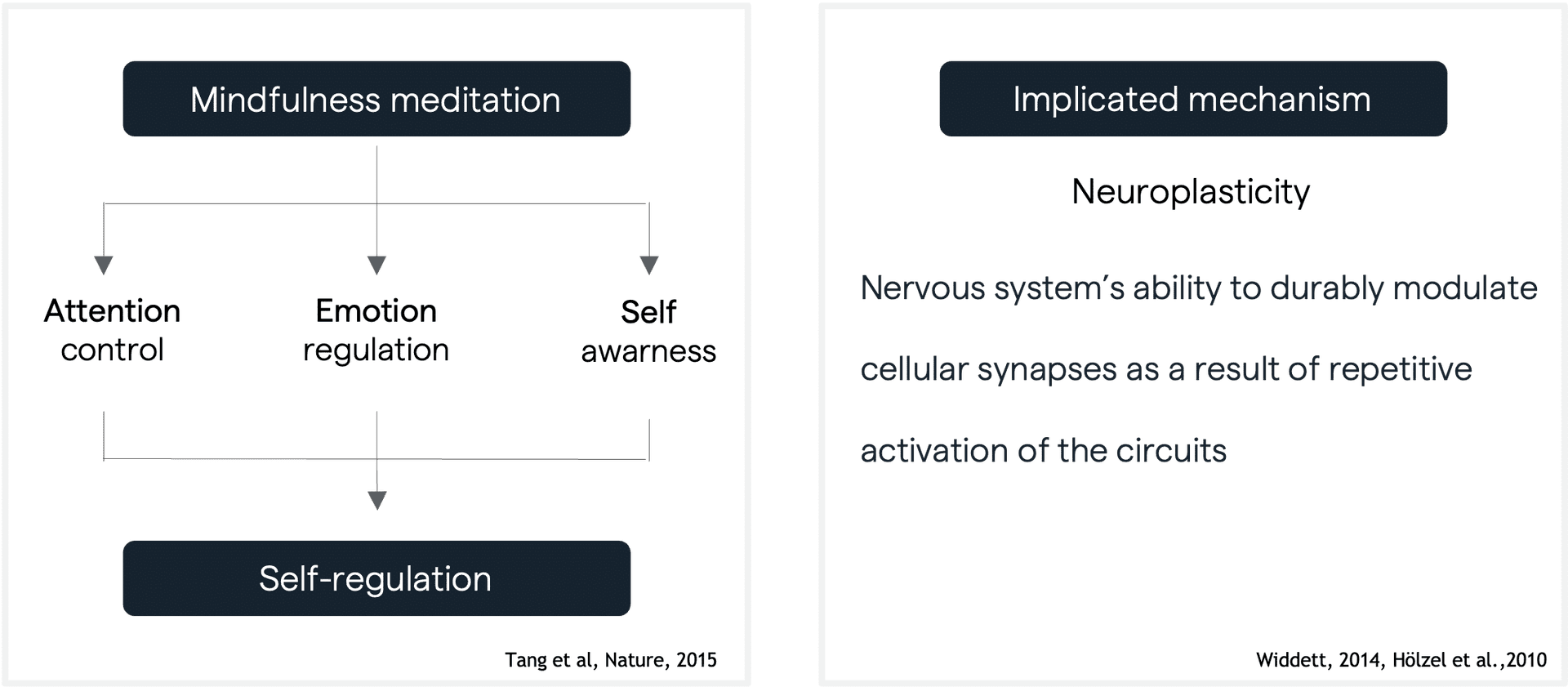
Mindfulness meditation and Default Mode Network regulation in depression
Mindfulness meditation working principles.
03

A Closed-Loop Solution Built to Target the Neural Roots of Relapse

Platform.

Neuromind combines wearable EEG sensors, artificial intelligence, and immersive virtual reality within a closed-loop system. For depression, it is designed to directly address the DMN overactivity and attentional dysregulation that drive relapse — complementing rather than replacing existing clinical protocols.

01

Real-time neurofeedback

EEG biomarkers detect DMN overengagement and guide patients toward more regulated attentional states.

02

Mindfulness-based training

MBCT-aligned components, made measurable and more accessible through immersive guided sessions.

03

Adaptive environments

VR environments that respond to the patient's neurophysiological state, reinforcing attentional stability.

04

Technology Foundation

Neurofeedback.

Real-time neurofeedback to downregulate DMN overactivity.

Neuromind continuously monitors EEG-derived biomarkers of arousal, attention, and emotional state. The system detects shifts in neural activity associated with DMN overengagement and provides real-time feedback through adaptive changes in a virtual environment, enabling patients to actively train their brain to shift out of ruminative states.

Over repeated sessions, this neurophysiological training may help reduce the automaticity of rumination and lower the threshold at which patients can recognize and interrupt early relapse-related thought patterns.

Mindfulness.

Mindfulness-based training, made measurable.

Mindfulness-based cognitive therapy (MBCT) is one of the most well-validated interventions for depression relapse prevention, in part because it targets the same DMN-driven ruminative processes that Neuromind addresses neurophysiologically. Neuromind integrates mindfulness-based training within an immersive virtual environment, offering patients real-time objective feedback on whether their brain state is actually shifting during practice — transforming mindfulness from a subjective exercise into a measurable, learnable skill.

Immersive VR meditation environment for depression treatment
Lake meditation environment in Virtual Reality.
Adaptive VR.

Adaptive environments that respond to the patient's state.

Rumination often intensifies in moments of unstructured mental drift. Neuromind addresses this by placing training inside virtual environments that adapt continuously to the user's neurophysiological state — adjusting visual and auditory elements to reinforce attentional stability and support sustained engagement with the present moment. The environment responds to progress rather than performance, making the experience personalized, non-judgmental, and progressively calibrated to each patient's regulatory capacity.

Neuromind prototype for depression relapse prevention
05

Designed for Integration, Not Replacement

Positioning.

Neuromind is designed as a precision augmentation layer that gives clinicians an objective, real-time window into the neurophysiological states underlying relapse vulnerability — and gives patients an active tool to train the regulatory capacities that protect against recurrence.

Outpatient psychiatric careInpatient programsMBCT protocolsStepped-care pathwaysTreatment-resistant depressionClinical research
06

Advancing the Evidence Base Together

Collaboration.

Neuromind is committed to building the rigorous clinical evidence needed for adoption in evidence-based depression care. We are actively seeking academic psychiatrists, clinical psychologists, and research institutions to jointly define clinical targets, develop and refine treatment protocols, and conduct early-stage validation studies.

If your institution is working on depression relapse prevention, DMN-targeted interventions, digital therapeutics, or neurofeedback-augmented psychotherapy, we would welcome the conversation.

Contact us to explore a partnership

VR neurofeedback targets the Default Mode Network, which tends to become overactive in depression. By combining real-time brain monitoring with immersive mindfulness environments, users learn to recognize and shift out of ruminative patterns before they escalate into depressive episodes.

Contact. If you would like further information or a demonstration of our solution, please contact us using the following link

contact us